
Data Center Earthing Design: Systems, Bonding and Testing
Earthing keeps people safe and lets protection operate; bonding keeps equipment at the same potential. A data center needs both, and the design goes beyond a single electrode.
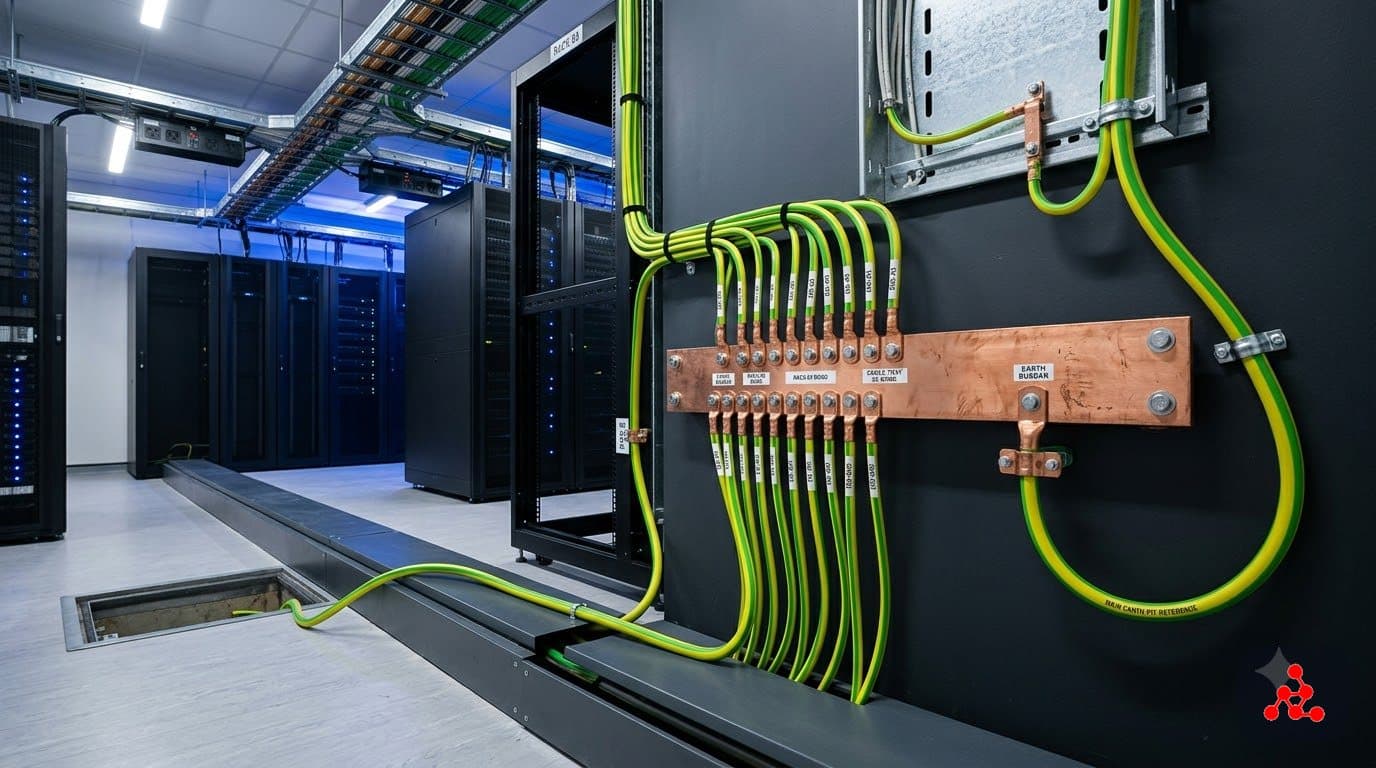
Earthing system types
| System | Idea |
|---|---|
| TN-S | Separate neutral and protective earth conductors throughout |
| TN-C-S | Combined neutral-earth in the supply, separated within the installation |
| TT | Installation earthed independently of the supply earth |
| IT | Isolated or high-impedance source with monitored first fault |
The choice follows the utility supply and the protection design; the project specification decides.
Bonding network
A data center needs more than safety earthing. A bonding network ties together racks, cable trays, raised-floor or structural steel and equipment frames so they share a common reference. It limits touch voltages, helps fault current return and reduces noise problems. Lightning protection earthing is bonded to the main earthing system, not left separate. See earthing and bonding basics.
Electrodes and testing
- Electrodes may be rods, plates, strips or a foundation (ring) earth, with test pits for access.
- Soil resistivity at the site decides how many electrodes are needed to meet the target.
- Measure the earth resistance on installation and again at intervals, because it changes with soil moisture. See the earthing resistance calculator.
Common mistakes
- Designing electrodes without a soil resistivity measurement.
- Isolating the lightning earth from the main earth.
- No bonding of cable trays and structural steel.
- Skipping periodic testing.
Related: lightning protection basics.
Written by the Vision Matrix Institute editorial team. Worked examples use stated, illustrative assumptions; check them against your project data, the applicable standards and manufacturer datasheets before use.
Frequently Asked Questions
What earthing systems are used in data centers?
The common types are TN-S, TN-C-S and TT, and sometimes IT for specific loads. Which one applies depends on the utility supply arrangement and the project requirements.
What is the difference between earthing and bonding?
Earthing connects the system to the general mass of earth. Bonding connects metallic parts together so they stay at the same potential, which reduces shock risk and equipment stress.
How is earth resistance measured?
Commonly by the fall-of-potential method using test electrodes, or by clamp-type testers where the arrangement allows. The target value comes from the project specification and applicable codes.
Which standards apply in India?
IS 3043 is the Indian code of practice for earthing. International projects commonly refer to the IEC 60364 series. Confirm which govern the project.
Want to learn this properly?
This topic is covered in depth in our Electrical Design – Data Center Specialist program.
Ask us on WhatsAppLearn to do this on a full project in the Electrical Design – Data Center Specialist program, or read the data center design guide.