
Harmonics in Data Centers: Sources and Mitigation
Almost everything in a data center draws current in pulses, not smooth sine waves. Those harmonic currents heat equipment and disturb the supply, and they are controllable.
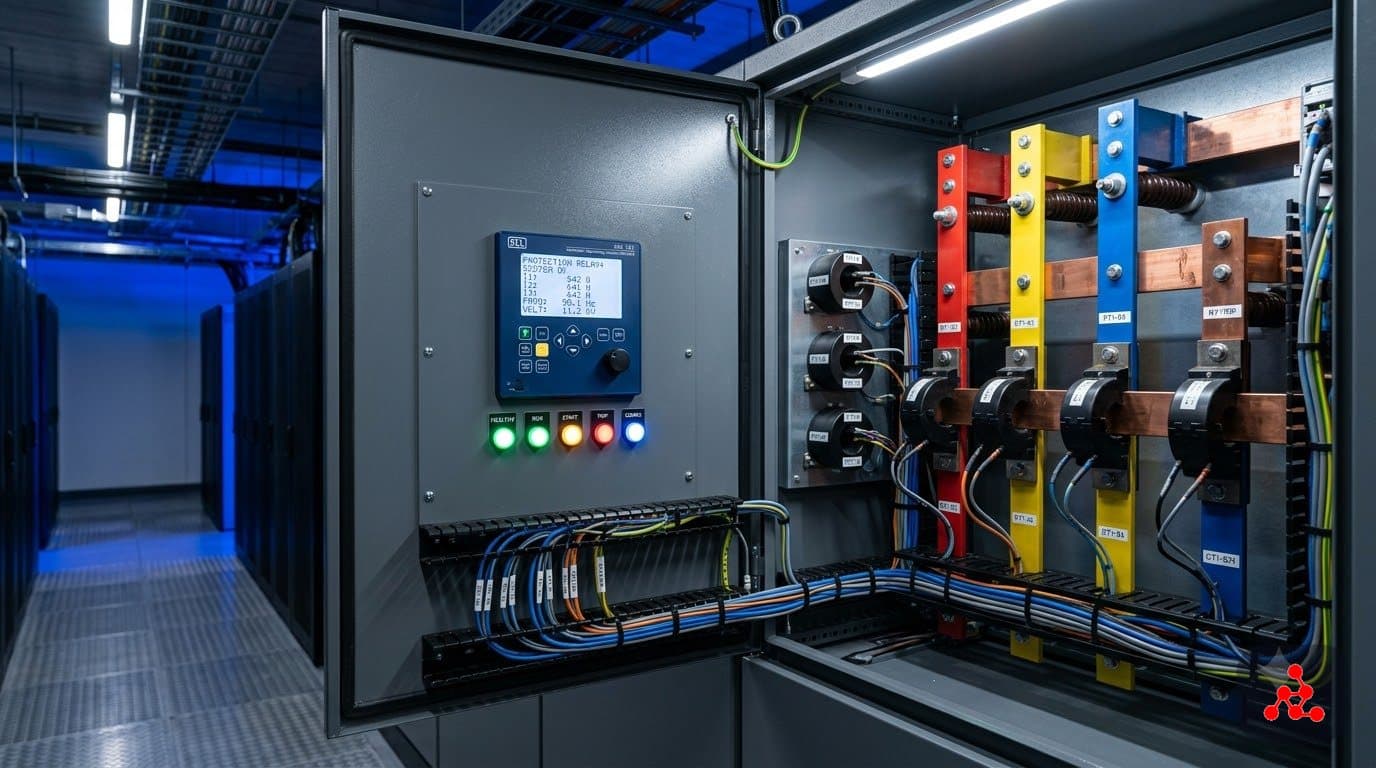
Sources
- UPS input rectifiers: six-pulse designs produce more harmonics than twelve-pulse or active-front-end designs.
- Server power supplies: switch-mode supplies draw pulsed current, often with triplen harmonics that add in the neutral.
- Variable-speed drives on cooling fans and pumps.
Effects
| Equipment | Effect |
|---|---|
| Transformers | Additional losses and heating; may need derating or a harmonic-rated unit |
| Neutral conductors | Triplen harmonics add and can overload the neutral |
| Generators | Voltage distortion and heating, since the source impedance is higher |
| Capacitor banks | Resonance risk, which can damage the capacitors |
Mitigation
- Specify equipment with low harmonic distortion and state the limits in the specification.
- Use passive or active filters where needed.
- Size neutrals and transformers for the harmonic content.
- Study the system, including generator operation and any capacitors, before finalising.
Related: power factor correction and UPS topologies.
Written by the Vision Matrix Institute editorial team. Worked examples use stated, illustrative assumptions; check them against your project data, the applicable standards and manufacturer datasheets before use.
Frequently Asked Questions
What causes harmonics in a data center?
Non-linear loads: UPS rectifiers, server power supplies and variable-speed drives draw non-sinusoidal current, which creates harmonic currents at multiples of the supply frequency.
What problems do harmonics cause?
Extra heating in transformers, cables and generators, overloaded neutral conductors, nuisance trips, interference, and a resonance risk with capacitors.
How are harmonics limited?
By selecting low-distortion UPS and drive front ends, using filters, sizing equipment for the harmonic load and checking the point of common coupling against the applicable limits, such as IEEE 519.
Do harmonics affect generators more than the utility?
Often yes, because a generator has a higher source impedance than the utility, so the same current gives more voltage distortion.
Want to learn this properly?
This topic is covered in depth in our Electrical Design – Data Center Specialist program.
Ask us on WhatsAppLearn to do this on a full project in the Electrical Design – Data Center Specialist program, or read the data center design guide.