
Busduct vs Cable for Data Center Power Distribution
Both carry power from the board to the load. They differ in how they handle high current, change and heat, and the right answer depends on the run, not on a general preference.
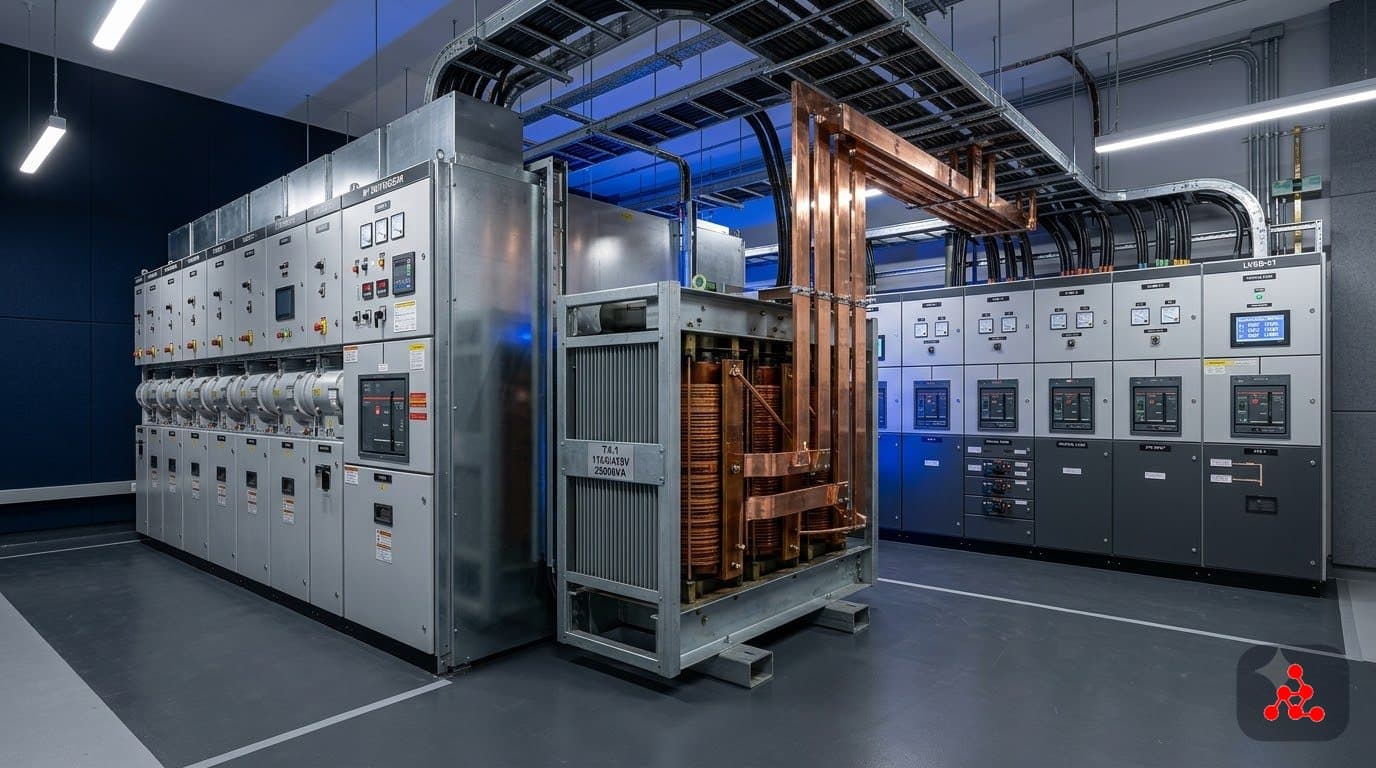
Side by side
| Aspect | Busduct | Cable |
|---|---|---|
| High current | Compact solution at high ratings | Needs many parallel runs, so more tray space |
| Changes after installation | Plug-in tap-offs make additions easier | New circuits need new cable runs |
| Routing | Prefabricated sections; fittings for bends | Flexible routing |
| Installation | Fast once the layout is fixed; needs accurate site dimensions | Pulling and terminating is labour-intensive for large sizes |
| Impedance | Lower than equivalent cable (check the product data) | Depends on size and layout |
| Fire and enclosure | Enclosed; check fire barrier and IP ratings | Depends on the cable type and tray |
| Cost | Often higher at low ratings; competitive at high ratings and with many tap-offs | Usually lower for short, low-current runs |
The qualitative comparisons are general; verify each against the products and the project's conditions.
Where each is usually used
- Transformer to LV switchboard: busduct is common at high currents; parallel single-core cables are the alternative.
- Overhead to racks: busway with plug-in units gives flexibility to add or move rack circuits.
- Switchboard to small distribution boards: cables.
How to decide
- Compare current rating and the number of parallel cables that would be needed.
- Count the expected changes over the facility's life.
- Check space: tray width versus busduct cross-section.
- Check fault withstand and short-circuit rating. See short circuit basics.
- Compare installed cost for the whole run, not price per metre.
Busduct and cable sizing are both covered by the conductor sizing calculator; see also MV/LV distribution architecture.
Written by the Vision Matrix Institute editorial team. Worked examples use stated, illustrative assumptions; check them against your project data, the applicable standards and manufacturer datasheets before use.
Frequently Asked Questions
What is the difference between busduct and cable?
A busduct (busway) carries current on enclosed solid conductors in a prefabricated housing, while a cable uses insulated conductors laid in tray, conduit or ground. Busduct is built in sections with joints and tap-off points; cables are cut to length and terminated.
When is busduct used in data centers?
Commonly for high-current runs between transformers and switchboards, and for overhead busway feeding rows of racks through plug-in tap-off units that make it easy to add or move circuits.
When are cables a better choice?
Cables are usually favoured for lower-current feeders, irregular routes and where circuits are fixed and few, because they are flexible in routing and cost-effective at small ratings.
Is busduct more expensive?
Cost depends on rating, length and the number of tap-off points. Compare the installed cost of the whole run, including supports, terminations, labour and future changes, rather than the price per metre.
Want to learn this properly?
This topic is covered in depth in our Electrical Design – Data Center Specialist program.
Ask us on WhatsAppLearn to do this on a full project in the Electrical Design – Data Center Specialist program, or read the data center design guide.