
Data Center Tier Classification Explained (Tier I–IV)
Ask someone to name the four data center tiers and most people can. Ask them what actually changes between Tier II and Tier III, and the answers get vague fast. Here's the engineering underneath the label.
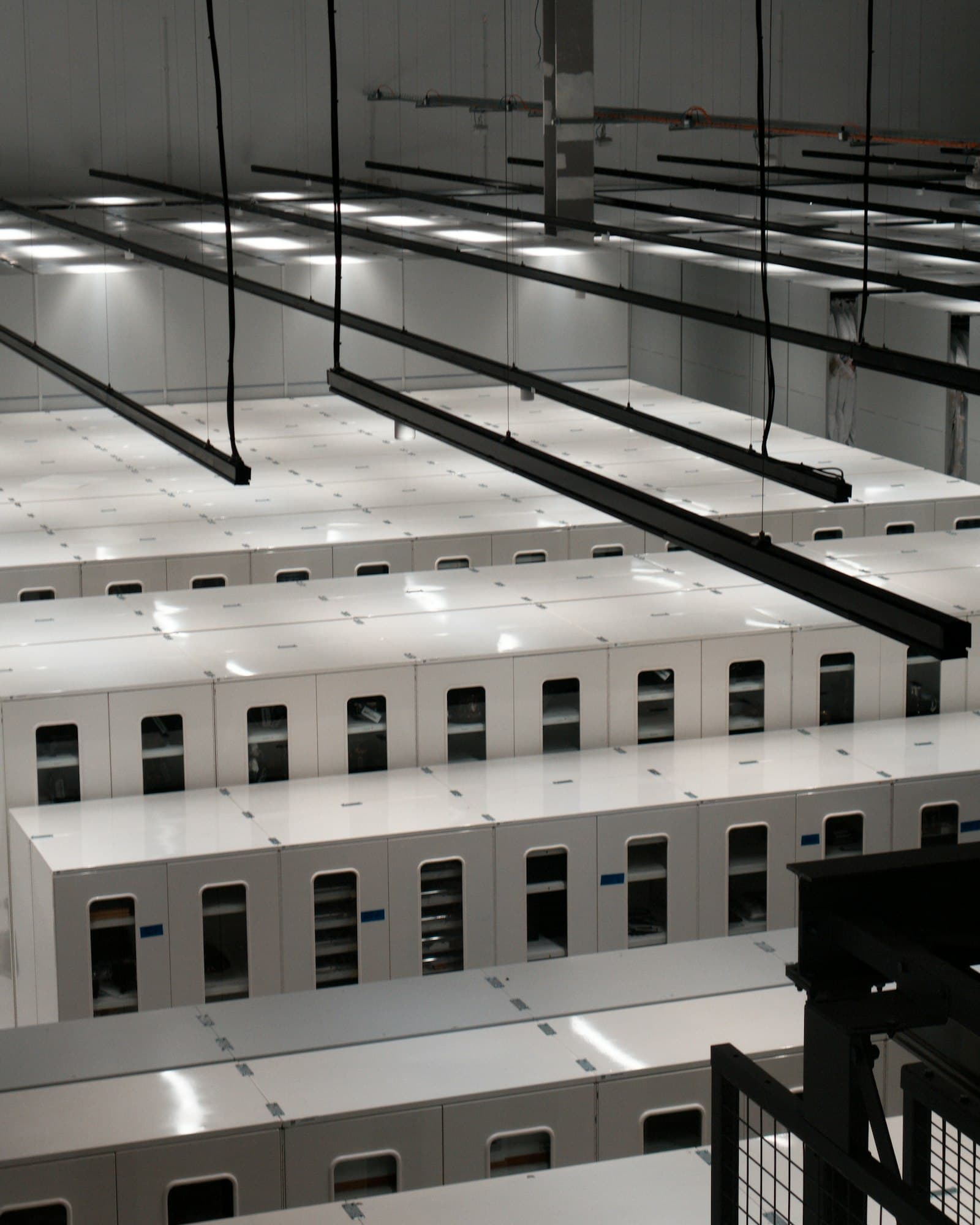
Tier classification answers one question
When someone tells you a facility is "Tier III," the only question that actually matters is: what happens when a component fails, or needs planned maintenance? The Uptime Institute's four-tier system, published in its Tier Standard, ranks data center infrastructure purely on capacity redundancy and maintainability — not on cooling technology, security posture, or IT architecture. It's an engineering answer, not a marketing label, and every tier above Tier I exists to close a specific gap the one below it leaves open.
Tier I — Basic Capacity
A single, non-redundant path for power and cooling. No redundant capacity components — a transformer, UPS module, or chiller failure takes the whole facility down until it's repaired. Planned maintenance requires a full shutdown. Uptime Institute publishes an expected availability of 99.671%, which works out to roughly 28.8 hours of downtime a year.
Tier II — Redundant Capacity Components
Adds redundant capacity components (an extra UPS module, an extra chiller) on top of the Tier I single path. A single component can fail without an outage, but the distribution path itself is still singular — planned maintenance on that path still requires downtime. Published availability: 99.741%, about 22.7 hours a year.
Tier III — Concurrently Maintainable
This is where the requirement changes shape, not just scale. Tier III requires that every capacity component and every distribution path can be taken out of service for planned maintenance without any impact on IT load. That means multiple independent distribution paths, not just spare capacity sitting on one path — one path serves the active load while the other is worked on. Most colocation and enterprise data centers target Tier III specifically, because it removes planned- maintenance downtime without the cost of full fault tolerance. Published availability: 99.982%, under two hours a year.
Tier IV — Fault Tolerant
Tier IV adds fault tolerance: the facility must continue operating even after any single unplanned failure of a capacity component or distribution path, not just planned maintenance. In practice this means fully independent, physically separated distribution systems (commonly described as 2N or 2(N+1)) with automatic fault detection and isolation, so a single fault never propagates to affect critical load. Published availability: 99.995%, about 26 minutes a year — the tightest bar in the standard, and the most expensive to build and operate.
Two classification systems people mix up
The Uptime Institute Tier system isn't the only framework in play. TIA-942, a telecommunications infrastructure standard, defines its own Rated-1 through Rated-4 levels with criteria that loosely track the Uptime tiers but aren't identical to them — a facility can meet one system's criteria for a given level without automatically meeting the other's. A design document that cites "Tier III" when it means "TIA-942 Rated-3," or vice versa, without checking the specific criteria of the system it's actually claiming, is a real, recurring error in early-career design work — and exactly the kind of detail a hyperscaler RFP's compliance matrix will catch.
Why this drives real design decisions
Tier level isn't decided after the electrical design — it's the input that shapes it from the first line diagram. Redundancy topology (N, N+1, 2N, 2(N+1)), UPS configuration, distribution path count, and switchgear arrangement all follow directly from which tier a project is targeting. Get the tier requirement wrong at the concept stage, and the rework touches every downstream calculation — load schedules, cable sizing, single-line diagrams, and layout all have to be redone against the correct redundancy target.
Frequently Asked Questions
Is Tier IV always the right choice for a project?
No — it's the right choice when downtime cost justifies the extra capital and operating cost. A Tier IV facility costs significantly more to build and run than Tier I or II. Most colocation and hyperscale facilities target Tier III specifically because it's the point where concurrent maintainability is achieved without doubling the entire infrastructure the way Tier IV's fault tolerance requires.
Can I just add a backup generator and call a facility Tier III?
No. Concurrent maintainability means every capacity component and every distribution path can be taken offline for maintenance without affecting IT load — not just the generator, but switchgear, UPS, PDUs, and cabling too. A single extra generator without redundant distribution paths to route around it during maintenance doesn't meet the Tier III bar, even though it adds real redundancy.
Are Uptime Institute Tiers and TIA-942 Rated levels the same thing?
No, and mixing them up is a common mistake. The Uptime Institute Tier system (I–IV) is a facility certification framework focused on infrastructure topology and operational sustainability. TIA-942 Rated-1 through Rated-4 is a telecommunications infrastructure standard with its own criteria that map loosely, but not identically, to the Uptime tiers. A design citing 'Tier III per TIA-942' without checking which system's specific criteria are actually met is exactly the kind of mismatch a bankable design document can't afford.
Does a higher tier mean better cooling or better security?
Not directly. Tier classification is about electrical and mechanical infrastructure redundancy and maintainability — it doesn't independently score physical security, cooling technology choice, or IT architecture, though a facility rarely invests in Tier III/IV redundancy without also investing more broadly across the board.
Want to learn this properly?
This topic is covered in depth in our Electrical Design – Data Center Specialist program.
Ask us on WhatsAppRead more: All articles or explore the Electrical Design – Data Center Specialist program, which covers Uptime, TIA-942-C, IEC, IEEE, NFPA, and ASHRAE standards as a full module.