
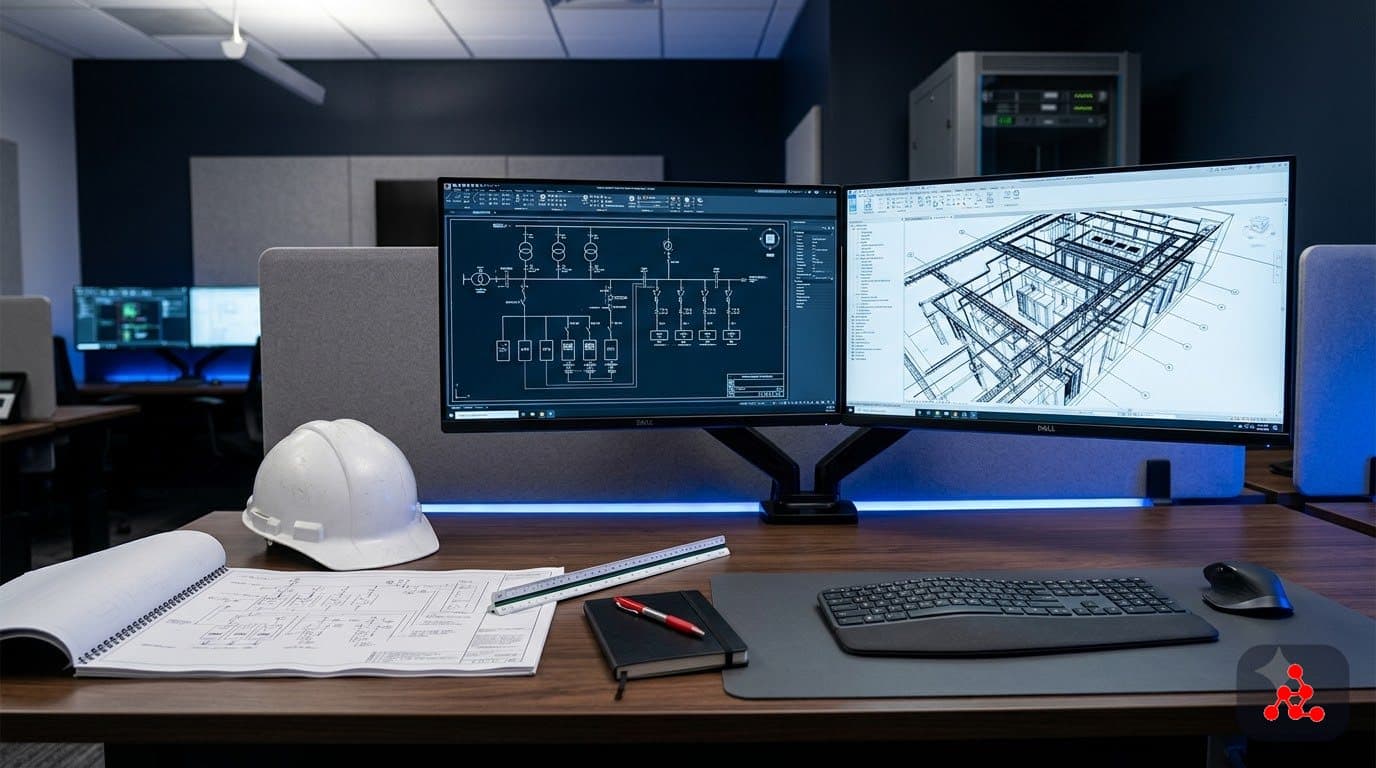
What Does a Data Center Electrical Design Engineer Do?
A data center electrical design engineer is responsible for the complete electrical power path of a mission-critical facility — from the utility interface at the site boundary, through medium-voltage transformers and switchgear, UPS systems and battery banks, standby generators, low-voltage distribution, and all the way down to the busway and rack-level power distribution units that feed IT equipment.
Unlike general building electrical design, every decision in a data center is anchored to a reliability target. Facilities are designed to Uptime Institute Tier I-IV classifications or TIA-942 Rated 1-4 levels, and the engineer's job is to translate a reliability requirement (concurrent maintainability, fault tolerance, N+1 or 2N redundancy) into a distribution architecture, then prove — through short-circuit studies, arc-flash analysis, protection coordination, and voltage drop calculations — that the design actually delivers it.
The day-to-day work spans single-line diagram production, load calculations, equipment sizing (transformers, UPS, generators, switchgear), system studies in tools like ETAP, BIM coordination in Revit MEP, vendor technical bid evaluation, and support through factory acceptance testing, site commissioning, and integrated systems testing before a facility goes live.
Why This Career Path
Electrical infrastructure typically represents 40-50% of a data center's capital cost and virtually all of its criticality — a single design flaw can render a facility unable to meet its SLA or cause catastrophic downtime for tenants. That combination of capital weight and consequence is why owners pay a premium for engineers who can demonstrably get it right.
The demand signal is strong and public. India alone is projected to add over 1,000 MW of data center capacity by 2027, global hyperscale build-out has crossed 40 GW of cumulative IT load, and the AI compute boom is pushing rack densities from a legacy 5-20 kW toward 100+ kW — forcing a full redesign of electrical topologies industry-wide. Major EPC firms, consultancies, and hyperscale operators have publicly reported hiring shortfalls specifically for data-center-experienced electrical engineers, which is what pushes compensation for this specialization meaningfully above general MEP roles.
Skills & Requirements
The baseline entry requirements for this specialization are:
- A Bachelor's degree (BE/BTech) in Electrical Engineering, Electrical & Electronics Engineering, or Electronics & Instrumentation — or a Diploma in Electrical Engineering with at least three years of relevant industry experience.
- Comfort with three-phase AC power theory and elementary electrical calculations.
- Familiarity with reading and marking up electrical drawings, including single-line diagrams.
- A basic understanding of transformers, switchgear, cables, and protection devices.
- Working knowledge of at least one drafting tool such as AutoCAD is strongly preferred.
Beyond the technical baseline, the specialization rewards engineers who can hold both the calculation and the construction detail in mind at once — this is not a purely theoretical discipline; every study needs to end in a buildable, defensible deliverable.
Tools & Software
Modern data center electrical design is not delivered on paper. The tools that shape daily practice fall into four categories:
Design & Drawing
AutoCAD Electrical, Revit MEP, Navisworks, Bluebeam Revu, and BIM 360 for coordination workflows.
Analysis & Studies
ETAP and SKM PowerTools for load flow, short-circuit, arc-flash, and protection coordination studies; DIgSILENT PowerFactory for MV transient and dynamic simulation on larger projects.
Lighting
Dialux evo for illuminance calculations and lighting layout verification.
Programme & Documentation
Primavera P6 or MS Project for scheduling, and advanced Excel for the calculation sheets that underpin every study.
Certifications That Matter
A structured curriculum anchored in current standards is the foundation, but several certifications are widely recognised as markers of specialization in this field:
- Uptime Institute Accredited Tier Designer (ATD) and Accredited Tier Specialist (ATS) — the most widely recognised data-center-specific design credentials globally.
- CDCP, CDCS, CDCE (from EPI/CNet) — data center professional certifications spanning foundational to expert levels.
- Chartered Engineer status through a national institution of engineers (e.g. IE(I) in India) or equivalent.
- Professional Engineer (PE) licensure through bodies like NCEES, where applicable to the jurisdiction.
Every calculation, drawing, and specification in a serious design program should be traceable to a specific clause of IEC, IEEE, NFPA, TIA, IS, or Uptime Institute standards — that standards discipline is what these certifications ultimately validate.
Salary Expectations
Indicative 2024-2025 compensation ranges for engineers with data center electrical design competence:
| Region | Mid-Level (3–7 yrs) | Senior / Lead (8–15 yrs) |
|---|---|---|
| India (Metros) | ₹ 12 – 25 LPA | ₹ 28 – 60 LPA |
| UAE / KSA / Qatar | AED 240K – 420K | AED 480K – 900K |
| Singapore / SE Asia | SGD 90K – 150K | SGD 180K – 320K |
| UK / EU | £ 55K – 90K | £ 100K – 160K |
Ranges are indicative only — actual compensation depends on employer, project scale, and certifications held.
Who Hires for This Role
The hiring landscape for this specialization spans four categories of employer: large EPC and engineering contractors delivering turnkey data center projects, specialist MEP design consultancies serving hyperscale and colocation clients, the in-house engineering teams of hyperscale operators and colocation providers themselves, and equipment vendors and system integrators (UPS, switchgear, and generator manufacturers) who employ application engineers with the same skill set.
In India, job postings for this specialization concentrate around the country's major data center clusters — Mumbai, Chennai, Hyderabad, Pune, and the NCR region — tracking where hyperscale and colocation capacity is actually being built.
Career Progression
This specialization supports a career arc spanning two to three decades, typically progressing through the following stages:
How to Get Started
The fastest, most defensible path into this specialization is a structured, practitioner-led program that combines standards-anchored theory with hands-on tool training and a real capstone deliverable — not a series of disconnected tutorials. Look for a curriculum that covers the full scope end-to-end: tier classification and reliability frameworks, power distribution architectures, MV systems and transformers, UPS and generator sizing, protection engineering, short-circuit and arc-flash studies, earthing and lightning protection, load calculations and cable sizing, LV switchgear design, BIM coordination, and commissioning — finishing with a portfolio-ready capstone project you can defend in an interview.