
Transformer Cable Sizing: LV Secondary Cables in Parallel
A large transformer's secondary current is too high for a single cable, so the connection is made with parallel runs. Sizing means choosing how many, then checking the fault case.
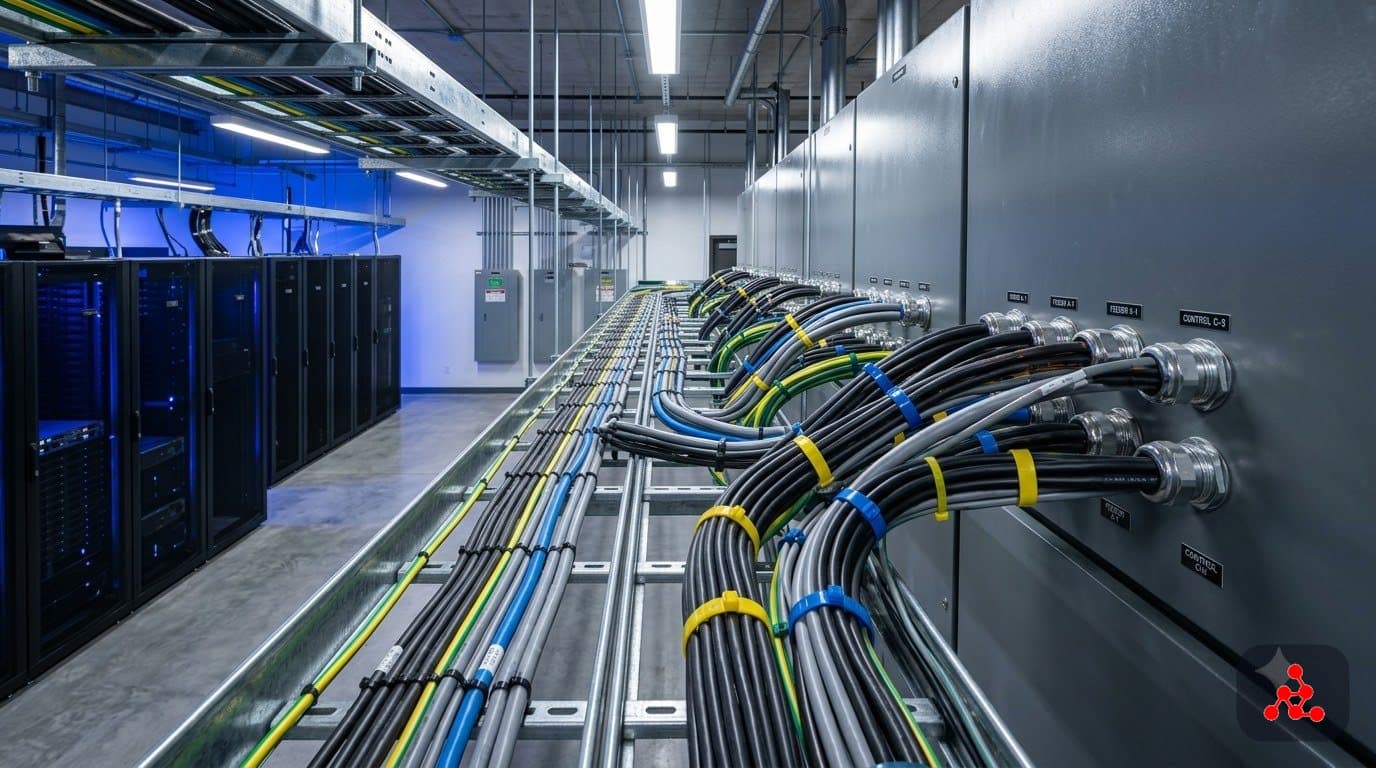
The example and its assumptions
Illustrative example. A 1,600 kVA transformer, 415 V secondary, 6% impedance. Assume the derated current rating of one chosen cable is 650 A (take the real value from the manufacturer's tables for your installation) and the fault clears in 0.5 s. Copper XLPE with k assumed as 143.
Step 1: Full-load current
I = 1,600 ÷ (1.732 × 0.415) = 2,226 A.
Step 2: Number of parallel cables per phase
2,226 ÷ 650 = 3.4, so use 4 cables per phase. Four cables share the current at about 557 A each. Choosing the number first and the size second is common, since the size per cable follows from the derating.
Step 3: Short-circuit withstand
The infinite-source fault level is about 2,226 ÷ 0.06 = 37.1 kA. With four cables sharing it, each carries about 9.3 kA, so the minimum area for each is 9,300 × √0.5 ÷ 143 = about 46 mm². That is well below the area the ampacity requires, so ampacity governs here. See short circuit basics.
Step 4: Voltage drop
The run from transformer to board is short, so the drop is small, but check it with the formula in the voltage drop article using the current per cable.
Practical points
- Keep parallel cables the same length and route so they share current evenly.
- Allow for the neutral and earth conductors according to the system.
- Check termination space on the transformer and the board for the number of cables.
- At very high currents, compare with busduct. See busduct vs cable.
The transformer sizing calculator gives the full-load current, and the cable sizing calculator runs the checks.
Written by the Vision Matrix Institute editorial team. Worked examples use stated, illustrative assumptions; check them against your project data, the applicable standards and manufacturer datasheets before use.
Frequently Asked Questions
How do you size cables for a transformer?
Calculate the full-load current, apply an allowance for overload and growth if the design requires it, divide the current across parallel cables using their derated ratings, then check short-circuit withstand and voltage drop.
Why use parallel cables?
Single cables are limited in size, and very large sizes are hard to handle and terminate. Several smaller cables per phase carry the current more practically.
What matters when cables run in parallel?
They should be the same length, size and material, and laid so they share current evenly. Unequal sharing overloads one cable.
Is busduct an alternative?
Yes, at high currents. See the busduct vs cable comparison.
Want to learn this properly?
This topic is covered in depth in our Electrical Design – Data Center Specialist program.
Ask us on WhatsAppLearn to do this on a full project in the Electrical Design – Data Center Specialist program, or read the data center design guide.